I'm not against start-ups. I'm not against innovation. I enjoy Silicon Valley (the HBO show) for its satire.
I came across this today:
"... is a well-funded advanced technology company, backed by top VC firms, with the intent to completely disrupt the metal additive manufacturing industry."
How do you disrupt an industry that is barely past its infant years?
Friday, February 17, 2017

Friday, February 10, 2017
My story
Tell the story of your life
This post is a few weeks late.
I read this article several weeks ago. Coincidentally, I also came across it before heading out to an interview. The on-site interview process involved three one-on-one behavioral interviews, several technical "interviews" with different groups of the company, and a 30-40 minute presentation. Before heading out to the interview, I gave a practice presentation to my research group. The advice/criticism I received?
"You're not presenting about your research. You're presenting to sell yourself."
I thought from reading the article, I understood it. Although when I gave the practice presentation, it turned out I didn't. Refining my presentation to tell the story of me, was far more challenging than I expected, especially when every PowerPoint presentation I gave was a technical presentation.
I always believed my story was boring, especially as I've always stayed in the academic setting. I started doing undergraduate research the summer of 2008, after I failed to find an internship. The research project on water purification using metal oxide nanoparticles led to the WaterCampws REU for the next two years. The REU opened up to me the various aspects of academic research between writing, making posters, preparing presentations, attending seminars, and so forth. I graduated, applied to graduate school, and found myself at Carnegie Mellon University. When I came I envisioned working with the next generation of biomaterials, but instead I found myself fascinated by grain boundary engineering and microstructure evolution. I defended my thesis as an expert on annealing twins, grain growth, recrystallization, and microstructure characterization, and then found myself doing a post-doc next. At NIST, I changed gears again (but this time at least still working on microstructure and metals), focusing on deformation and formability of sheet metals.
 While in a technical presentation nobody would ever care about this story, and I myself didn't think much of it at first, I realized it showed my flexibility to change between fields and my adaptability to become an expert (maybe not the leading expert) of a topic.
We all have a story to tell. What's yours?
This post is a few weeks late.
I read this article several weeks ago. Coincidentally, I also came across it before heading out to an interview. The on-site interview process involved three one-on-one behavioral interviews, several technical "interviews" with different groups of the company, and a 30-40 minute presentation. Before heading out to the interview, I gave a practice presentation to my research group. The advice/criticism I received?
"You're not presenting about your research. You're presenting to sell yourself."
I thought from reading the article, I understood it. Although when I gave the practice presentation, it turned out I didn't. Refining my presentation to tell the story of me, was far more challenging than I expected, especially when every PowerPoint presentation I gave was a technical presentation.
I always believed my story was boring, especially as I've always stayed in the academic setting. I started doing undergraduate research the summer of 2008, after I failed to find an internship. The research project on water purification using metal oxide nanoparticles led to the WaterCampws REU for the next two years. The REU opened up to me the various aspects of academic research between writing, making posters, preparing presentations, attending seminars, and so forth. I graduated, applied to graduate school, and found myself at Carnegie Mellon University. When I came I envisioned working with the next generation of biomaterials, but instead I found myself fascinated by grain boundary engineering and microstructure evolution. I defended my thesis as an expert on annealing twins, grain growth, recrystallization, and microstructure characterization, and then found myself doing a post-doc next. At NIST, I changed gears again (but this time at least still working on microstructure and metals), focusing on deformation and formability of sheet metals.
We all have a story to tell. What's yours?
Tuesday, December 20, 2016
Explain like I'm 5
One of my Facebook friends recently saw my NADDRG 2016 Fall Symposium talk titled, "X-ray Stress Measurements during Multi-axial Deformation."
He commented, "ELI5" (see title)
It's taken me over two weeks to get back to him, but this was my response:
Grab something by one end in one hand and the other in other hand. Maybe it's a piece of tape or strip of paper. Pull the ends apart from one another slowly and you're performing a uniaxial (single axis) tension experiment. As you deform the material, that change in length compared to its starting length is how much you strain the material by, and how much force you need to keep that strain is the stress.
Now let's take a sheet of paper. You're going to grab two sides of the sheet and someone else will take the other two. You guys will both slowly pull, so now you're stretching the sheet. This is multi-axial deformation now (in this case with two perpendicular axis). For uniaxial deformation, we have a pretty good idea of the math to relate the strain and stress, but this is not the case in multi-axial deformation.
To find the relationships between strain and stress in multi-axial deformation, we have ways to find the strain, but not so much the stress. To solve this, we use x-rays to look at what's happening at the atomic level. Materials are made out of atoms and those atoms are ordered. When we pull on a material, those atoms also move apart from one another. We can relate that separation of atomic distances to a stress, but we can't see those distances with our eyes.
X-rays are amazing. How we use x-rays here is not like medical imaging when a doctor wants to see your bones. We use x-ray diffraction to find the separation of those atomic distances. Think about when you shine light onto you hand in a room and look at the shadow behind it. The shadow has the same shape as your hand but is much larger than your actual hand. This is a simplified idea, but we use x-rays in the same way to magnify and observe those separations in atomic distances in the material during multi-axial deformation to get desired information about the stress.
How'd I do?
*Corrected for typos at 11:27 pm courtesy of my editor
Saturday, August 13, 2016
Learning
For a while I wasn't happy with my post-doctoral position, and I should have been. I was in a position as a Materials Research Engineer, which means I still got to do materials-related research. I was in an environment where the pace of work was relaxed, enabling one to look at tangents when they came up (but ideally before you get too far and don't write up your previous results). Most importantly, as a post-doc at my work place, I had the freedom to determine my project. I dictated my research for the next two years.
Some of the problems I had was that I really wasn't doing any more materials research. I was researching on materials, but I felt much more like a mechanical engineer than materials scientist. When I went to the last two conferences I mentioned, I realized how much I missed microstructure-related science. Whether it was discussing improvements and novel techniques in microstructure characterization, or the details and complexity of microstructure evolutions during deformation, recrystallization, and grain growth. Additionally, because I felt outside my realm of expertise as well, I was easily frustrated when obstacles and set-backs occurred and I didn't know how to get around them.
It wasn't until I was catching up with my colleague at Carnegie Mellon University that my work attitude turned around. While she (another post-doc) was still getting to continue a similar line of work to her PhD, she reminded me that I was getting the chance to learn new techniques like digital image correlation and new fields like sheet metal forming.
This conversation reminded me of why most of us pursue a PhD in the first place. It's the opportunity to keep learning, whether to keep becoming an expert in a field you're in, which was what I thought needed to be happy, or branching out into a new area, which I am happy with where I'm at now.
Tuesday, July 19, 2016
Behind on updates again...
Back to back conferences though! I guess this is what they mean when they say, "If you love what you do you'll never work a day in your life." =P
Last week I was at the following learning a lot of 3D microstructure characterization and properties. The main takeaway I had is that grains are simply blobs in space, and if grain boundaries do exist, they are entirely flat boundaries. (This is a joke).

This week I'm focusing on recrystallization and grain growth. So far, the talks on the first day have been great and I look forward to the rest of the week.

Hopefully more updates will come after my two week work "vacation."
Friday, July 8, 2016
LMFIT and Peak-Fitting of XRD peaks
I recently added the Non-Linear Least-Squares Minimization and Curve-Fitting (LMFIT) package to my Python. Lately I've made an effort to move away from MATLAB and use Python and the packages available for it to take on some of my scientific problems.
I've been using the Gaussian model and composite model feature of LMFIT to reproduce a fitted diffraction profile as close as possible to what the manufacturer's software provides me. In the software, the fitting procedure determines the position of 2theta to determine the d-spacing of the crystal structure by Bragg's law. The stress is then calculated based on the change in d-spacing or lattice strain (gross oversimplification). The software ignores the information that exists within the peak, such as peak width that can reflect a dislocation content or the peak shape that may influenced by the twin density. Hence my goal is to reproduce the fitting procedure and determine the peak characteristics such to hopefully find more information.
Below outlines my fun so far in trying to replicate what the manufacturer does for peak fitting. This is an example of a diffraction peak, that has been fitted with a Gaussian curve:

This is the output that the software reports:

One distinct difference right away is that two peaks are used to fit the diffraction profile. Obviously I'm already off to a bad start. For those curious, this is because both the K alpha1 and alpha2 are used during the measurement, so there is in fact two signals. This was my next attempt just using two Gaussian curves.


Not even close. Although the fit is actually better than the manufacturers, it has no physical reasoning. So I enforced some rules on the intensity of the two radiations as well as the expected separation of the two peaks and came out with this:

The constraints actually made my fit "worse" compared to when the summation of the two Gaussian curves were left unbounded, but at least now I'm little closer to what the manufacturer reports. The next constraint I added was to assume the interaction profile of both radiation types would be same same in terms of variance, which gave me this:

Then the end of the day rolled around and I called the quits =P
Overall though using LMFIT was pretty intuitive and seemed to offer a lot for optimized fitting routines. I'm hoping to use more of it in the future for my work.
Wednesday, June 22, 2016
CHiMaD Materials Design
Last week I participated in the CHiMaD Materials Design Workshop held on NIST. Greg Olsen gave a keynote talk to kick things off, introducing to us the concept of System Design Charts, specifically focused for materials science and engineering and focusing on the paradigm of processing, structure, properties (and sometimes performance). The idea is such design charts enable one to target the important areas of interest to investigate and focus on, but also being able to communicate better on what one is investigating. This makes sense from an industrial standpoint when one needs to talk with shareholders or clients of a consulting firm, but can also be applied academia so that members within a research group can keep track of what each person is working on specifically, while still seeing the big picture.
To be honest, there is nothing special with the System Design Charts. It's simply just another tool that one can use to organize their thoughts and convey their ideas on where to go next. It's a strategic planning tool (like SWOT or anything else) to keep groups focused on the important parts of the big picture, rather than investigating small parts of interest.
First, one lays out all the processing steps in a sequential manner. The processing steps will influence the structure of the material. This may be the literal crystal structure (if we're talking about metals), but also things such as phases, precipitates, or features like twins. The lines that connect the processing boxes and structure boxes are two-way, such that processing will directly influence structure, but the resultant structure can also influence subsequent processing. Properties sit on the side other structure, and highlight what structures are connected to what properties the most, again as a two-way connection. Optional is putting performance on the other side of properties.
Designing the chart this way, one attempts to solve the problem in determining how to optimize the processing to influence the properties of most interest, where the monetary interest lies. There's nothing special about this, except that the structure column clears up the historic blackboxes that we tried to directly correlate properties to processing. From what I understood, therein lies the materials design by considering the actual structure of the material and the impact it plays on the properties. As a materials science major, this is all something one learns in a first-year class. Looking from a bigger picture though, the tool tells you where money can be made, which for a scientist may not sit right.
Alternatively, it was introduced to us that such a concept can be applied to any science, which was the goal of the workshop. This was my attempt at a Monte-Carlo grain growth scheme (no money to be made here =P):

Sunday, June 19, 2016
2016 DOE-AMR Vehicle Technologies
Last week I had the opportunity to participate as a reviewer for the Department of Energy (DOE) Annual Merit Review (AMR) in Vehicle Technologies, specifically propulsion materials. This past Friday, I finally submitted the two reviews assigned to me.

With a combination of procrastinating and not being 100% efficient, two single reviews took me the entire afternoon. In my sample size of two, the second one was "easier" than the first one. I was talking to my lab director, and I mentioned that I did not think two reviews would take me so long.
The overall experience was interesting. The presentations that I attended were allotted 30 minutes each, with the presentation to be about 20 minutes and 10 minutes for questions and answers, with priority given to the reviewers. Unsurprisingly, some presenters still clearly went over the the 20 minute mark, like in any other conference. Although this was not like any other conference. For one, there was no conference fee. Secondly, the contents of the presentation were organized in a way that made the review process challenging for me as a first-timer.
Reviews needed to cover their approach, their technical content, their collaborations, and their future work. Often collaborations are quickly glanced over and rated on a scale of 1-4 but almost seemed to be more of a check-box. The approach was where the objective of the project was generalized such that anybody could understand, and since most of these talks dealt with Integrated Computational Materials Engineering (ICME), typically presented a flow diagram as well. The technical content focused on what was achieved that year, and finally the future work covered what will be done for the next year, which at times seemed relevant to the technical content presented or other times seemed out of place before you realized you needed to look at the big picture.
Therein lied the challenge for me being a first-time review. I was reviewing projects that were both somewhere half-way complete, so in my head I couldn't see the complete picture at times of what had been accomplished before. And even in the technical content, it was a quick overview glance at the most major achievements, without digging deeper into the science at times. This made the merit of the future work even harder to judge. Lastly, I approach science with mostly a positive mindset (until I learn more and become a pessimist), so I think all approaches are generally valid and very cool. Then to score and comment each one of these categories on an arbitrary scale from 1-4...
Reviewing a project based a 20 minute presentation was unlike a reviewing a paper where you did have all the details. And as a scientist, details are important to us. I started making the effort to look up papers had been published, but most of this could not be found since it was all recent work. It took me awhile before I finally conceded and took a step back and judge the review based on what was presented to me (as well as last year's presentation. I realized I had to judge the project, and not necessarily the science (although it is a large part of it). I gave my input on the things I was impressed with, but also on what I thought could be use some more work or consideration. I hope in the future if I do this again, I'll also be able to give input on what I found was lacking (which comes with years of knowledge in the field...)
It was an experience to sit on the other side and be presented to, rather than making the presentations for my advisor as I had once done during graduate school.
Sunday, May 15, 2016
NADDRG 2016 Spring
Last Thursday I went to the North America Deep Drawing Research Group Spring Symposium.
 It was the first "conference" I've gone to since I've started my new position. I've placed conference in quotations since it was a single day of talks starting from 8:30am and ending at 6:00pm (although originally planned for 5:00pm). In that essence, it was like a conference in which some talks ran a little long, and there were always too many questions asked. Neither of which is bad, as the content was always interesting (at least in my opinion) and the questions brought up discussions between the audience. Furthermore, since there is only one talk at a time, there is no scramble from one room to the next like at the typical conference.
The speakers were well divided between industry and academia (and no one from a National Lab). The industry talks turned out to be equally as interesting as the academic ones. Sales pitches are not allowed, so the talks are typically focused on addressing an engineering problem or challenge without any superfluous information. Furthermore, the talks are designed to be either updates or works in progress (this is attributes for the large discussion aspect from the audience).
Two things that stood out for from these talks is the lack of microstructure characterization and discussion of crystal plasticity. It was a reminder that I was in a room of mostly mechanical engineers and not materials scientists. However during one of my side discussions with an engineer at Aleris, he expressed his surprise on just how things at the microscale influence the macroscale behavior. (Context: They found that special grain boundaries played a major role in crash-worthiness in aluminum. However I didn't get the chance to ask if these were Sigma3 boundaries or not, which would've been very interesting...).
My takeaway from all of this was the (micro)structure to property and performance relationships is equally important during forming/processing operations, and there is a large room for the development of these understandings.
Monday, October 12, 2015
5% Done...
It's scary that time is already passing by so quickly at my new job. While two-years seems like a long time for a post-doc, I am repeatedly reminded that two years will pass by in a flash. It seems ridiculous, although when I look back at graduate school, I can't disagree. There were times where I wasn't sure if I was a third or fourth year graduate student when research is the only thing you focus on and you topic or findings don't change significantly from one month to the next.
So far the new job has gone from intimidating to nostalgic and finally a little bit of fun. The intimidation comes from starting a completely new research project, where my first few days and weeks were completely focused on reviewing the current literature (to which I am still doing). Starting a new topic has made me feel like a graduate student again even though I just completed my PhD a few months ago. I just finished being an expert in one topic and then I'm thrown into something completely new again. While it is refreshing to change topics, it is also intimidating as everyone else expects you to become the expert. However, this is where everyone is correct on the PhD:
Getting your PhD is a sign that you know how to learn the important information in a new field, design the relevant experiments to test new ideas, and evaluate those findings to continue moving on.
The nostalgia, as I've already hinted at, is feeling like a new graduate student again with a new topic. Similarly I have a new "advisor" again as well as a research group (although with far more independence here). Although in the past few weeks I've had to taught how to using the mechanical testing frames, how to spray-paint for digital image correlation, and how to properly use the wet chemical fume hood for metal etching, all under the constant supervision of my sponsor. This reminded me of my undergraduate years, where each of my steps were carefully monitored. However instead of being tested for whether I was competent or not, it was just being taught for safe operating procedures. But nonetheless, to top it all off, I was told to wash beakers and cylinders.
The fun has been coming from the start of our mechanical testing of a TWIP steel sheet from a major supplier to better understand its forming limits. However, at the moment the material has not been been behaving as we expected. But I'm breaking a lot of stuff! And for an engineering, there's nothing better than that.
 |
| 7.5x7.5 in. square sheets (1mm) of TWIP steel subjected to balanced bi-axial testing in a Marciniak set-up. Failure is occurring on the lip or bend, rather than the center as desired. |
Wednesday, September 2, 2015
The Exit Interview
Overall I had an enjoyable graduate school experience in the Department of Materials Science and Engineering at Carnegie Mellon University. There were things I enjoyed a lot, although other things which I had some grievances too. That being said, no program is perfect and every one is unique.
Last Friday I had my "exit interview" with the department head. Having not been in any other programs, I don't know if this exclusively unique to our department alone or happens for many others. For every graduating PhD student, the department head tries to make a one hour appointment to before they permanently leave to cover a variety of topics. The generally cover the following:
- What class was most useful to you?
- What has provided you with the most professional development?
- What was your overall opinion of the program and structure?
- What do you feel was lacking or your least favorite thing in the program?
I've had an exit interview with my advisor. A mix of awkwardness of these are things that you did really well, there are the things that you can still continue improving, what are the things that I (the advisor) can do better, and then these are papers I (the advisor) want you to consider working on still. (The question that never goes away!)
For a department head to ask the similar set of questions shows a desire to improve the program based on a statistical collection of students opinion, rather that just hiring a professor with lots of potential and encouraging the department to increase the number of high impact journal publications. This is a department that will continue to strive to be better not based on research alone, but how it trains the next generation of scientists. Obviously, if you ask the opinion of my classmates, it's not perfect. And it never will be.
In retrospect, I wish I did a similar sort of thing with each and every undergraduate who worked under me as well as all the graduate students with whom I have collaborated with. I won't be the best scientist at the end of the day, but I'll be a better one than I was before.
In retrospect, I wish I did a similar sort of thing with each and every undergraduate who worked under me as well as all the graduate students with whom I have collaborated with. I won't be the best scientist at the end of the day, but I'll be a better one than I was before.
Tuesday, July 28, 2015
The Gordon Research Conference
My first "encounter" with the Gordon Research Conference (GRC) series was from Professor Michael Plewa. In my undergraduate research with virucidal materials for water purification, we started a collaboration with Professor Plewa for testing the cytotoxicity of our metal-oxide materials on mammalian cells. During that summer, we were rushing for results in one particular week as he was going to absent the next week for this Gordon Conference. (As we were working in his lab and his equipment, we needed to be under his supervision).
One of those days, Professor Plewa exclaimed his excitement for the upcoming conference. Of course, I had to ask what it was as I had neither heard of it nor thought anyone could get that excited over a single conference. The discussion was short, but memorable as he gave a brief summary that a GRC was one of the best things ever.
In pure delight, he told us that you had the best scientific talks in the morning, then open scientific discussion in the afternoon, then more talks in the evening, and then you drink the rest of the evening.
To make it better, you repeat all of this over the next few days.
The way he spoke of this made it seem to be the holy land of the scientific community. (Where as the holy grail would be publishing in Science or Nature I suppose). Not only was he going to be attending, but two of his students would be presenting posters as well. Professor Plewa was excited about attending, but also for his two students attending!
The last words he told us on this topic was, "If you ever have the chance, make sure you attend one."
So last week I attended my first Gordon Research Conference in Physical Metallurgy, and hopefully not my last one.
Saturday, July 11, 2015
Done... and not done...
I successfully defended the oral part of my dissertation yesterday (albeit a little bit rough again). My committee members signed their names down on the form to verify their approval (although they never checked the box for "pass"...) And then this question from a committee member/advisor came up:
"So what is your timeline for the papers after your thesis?"
 It never ends. The dissertation accounts for a large part for completing a PhD, although ultimately only a small part in the academic community. Needless to say, even after defending, I have a lot of work to be done in transforming my chapters to papers now.
The other amusing question, from colleagues, was, "How do you feel?"
To which my response is, "the same."
After completing such a large milestone, I don't feel any different amusingly. In fact the post-doc who asked me this question said this seemed to be the same response always. Your friend's start calling you, "Doctor" for fun (or sometimes "Philosopher"). However, there is research that still needs to be done. There are still questions that I cannot answer. There are always papers to be written.
Maybe in a few more days I'll feel different, but for now, back to fun questions =)
"So what is your timeline for the papers after your thesis?"
 It never ends. The dissertation accounts for a large part for completing a PhD, although ultimately only a small part in the academic community. Needless to say, even after defending, I have a lot of work to be done in transforming my chapters to papers now.
The other amusing question, from colleagues, was, "How do you feel?"
To which my response is, "the same."
After completing such a large milestone, I don't feel any different amusingly. In fact the post-doc who asked me this question said this seemed to be the same response always. Your friend's start calling you, "Doctor" for fun (or sometimes "Philosopher"). However, there is research that still needs to be done. There are still questions that I cannot answer. There are always papers to be written.
Maybe in a few more days I'll feel different, but for now, back to fun questions =)
Sunday, May 17, 2015
Graduation (but not mine)
While I wish I were graduating, it is coming soon enough. (Although maybe this whole arrangement of not defending until this summer and walking next May may work out better anyways for my family travel arrangements).
I went to my department's graduation again to see students that I've TAed as juniors (now graduating seniors obviously), PhD candidates who officially received their Master's degree, and my graduate classmates who are now officially Doctors (of Philosophy). While I'm envious of the gigantic diploma they receive (it's twice the size of my undergraduate one), I think I'm more envious of the next stages of their life that are moving onto. Not everyone knows what path they're going on or yet, but that too is part of life. The more important thing is moving forward with time.
If we stagnate, we become dull. I took a year off (voluntarily or involuntarily, I don't really know) between graduating from UIUC and starting graduate school. I didn't have an amazing reason too, like traveling the world, working (in fact the job market in 2010 was very tough and hence why I was unemployed), or conducting some breakthrough research.
I spent a summer more or less jobless. Although I would swing by the lab once in a while to synthesize some material, I had lost a lot of interest as well after working in the same lab for 2 years. We even had a new project to transfer the materials embedded fiber-glass system to a carbon system for higher loading and perhaps more promising applications. But I just found myself burnt from work.
So I found myself with the least research-relevant year. While working on my graduate school applications, I worked in a Frozen Yogurt store first as a cashier but eventually as a night-manager to handle closing and training of new employees. I worked as a teaching assistant in a biomaterials laboratory handling cell cultures and preparing materials for the students, alternating teaching the lab class with the instructor, and grading lab notebooks. I volunteered to work for my friend in sales in his new t-shirt company. I was constantly forced out of my comfort zone to interact with others. I learned a very different skillset from when I was in the college classroom.
I wasn't always sure if taking that year off was the right decision. I had the option to go to UCSD for graduate school, or I could've always worked a little bit harder to find a job. But we play with the cards that are dealt to us and move on. When my year was up, I didn't want to leave Champaign-Urbana for all the experiences I had, but it was time for me to move forward again, to have new experiences, and to not stagnate.
As I'm finishing up my thesis now, I might not have made it to graduating this May, but I'm also ready to move forward past my PhD career.
Monday, March 23, 2015
TMS 2015 Re-cap

I attended my last TMS conference (as a graduate student) last week in Orlando, Florida.
Aside from my qualms on Disney World as the location of the conference, I had a great time overall. Partially this was because of the great weather in Florida, but also just the breadth of talks and discussion at the conference and "out of the conference."
What do I mean by "out of the conference"? For everything else that wasn't officially on the conference schedule. This included stopping by the TMS socializer in the Presidential Suite, where along with my culprits, we were clearly not appropriately dressed and (jokingly) not important enough. But I did get a great view from being up on the 20th floor...
I can't network like my friend, although I had the opportunity to reconnect with a wide variety of people whom I had met when I first started graduate school and attended the first 3DMS conference and workshop back in 2012.
The conference itself was excellent with a wide assortment of topics and great speakers. Although this also presented an issue of questioning what I wanted to do in the future? There is a lot of development in synchrotron techniques to obtain better 3D information, providing the answers to some long-time questions (such as where do critical events like crack and voids nucleate). Although at the same time this open up many questions as well. Along that line, there is increasing focus on the microstructural aspect and role of material failure, i.e. what pair of grains lead to failure or enable provide slip transmission? Then there is still the field of recrystallization and grain growth, which has been gaining momentum again now that the 3D techniques allow us to confirm behaviors that were proposed in the past. While the development of Olmsted et al. 388 grain boundaries by molecular dnyamics in cubic materials have opened up a number of new findings regarding the grain boundary property (i.e. energy, mobility, etc.) landscape. Then there's still the issue of grain boundary networks...
But aside from all of this, I attended a great talk given by Dr. Michelle Dickinson, or alternatively nano-girl, (see her TED talk!). The symposium was organized by a group of Purdue graduate students, called, "Messaging Research to a Broad Audience." Her talk was titled, The Power of Small Words for Big Impacts." The focus is entirely on how to get the message across correctly to a layman and not another scientist, and how this is important in the scheme of public outreach as a scientist. She openly admits that she has taken a set-back in her career to do public outreach, but it has also opened up a very different career path compared to her fellow co-workers. In doing so, she has had the opportunity to go on TV and discuss science topics, meet the prime minister of NZ, and even Sir Richard Bronson. As a result, her funding hasn't always came from the government, but from private individuals instead. This, in my opinion, is quite an accomplishment.
I also had the chance to talk to her on what a graduate student can do to improve his or her public outreach. Her response: "Keep blogging."

Friday, February 13, 2015
The Right Track
I had my weekly meeting with my advisers yesterday, where I provide them a 30 minute update on what I've been working on.
Recently I've been finding my advisers less. Partially because I know what still needs to be completed before I can defend, and slowly I'm learning they don't necessarily have the answers I want for the things I'm investigating. Also I fear that by talking to them more would generate new scientific ideas, that would delay the experiments I already am behind / still need to perform. (Although I secretly think they've been finding me less as well to be rid of me...)
Our EBSD microscope has actually been down the last two months, so I've avoided doing any of the experiments that I need / actually should be doing for my defense. Instead, I've been revisiting some old data from the abnormal grain growth in nanocrystalline nickel, as well as generating synthetic microstructures with annealing twins to match real FCC microstructures. Neither of which, at the end of the day, will end up in my thesis.
So I gave my update yesterday on these two topics and the corrections that were made such that everything is "right" now. As the three of us were leaving the room, Tony made the remark that I looked like I was on the "right track".
I was on the right track for doing research that wasn't related to my thesis, especially when I'm expected to graduate in the next four or so months?
This led me to think, what is the right track for a PhD study (and for the purposes of this discussion focusing on US institutions). Should one focus on publishing three papers and get out? I know this is quite popular. Or should one just do whatever their adviser tells them to do, without question, and eventually follow the path given to their defense (with whatever publications along the way). Or should one do what I've been doing, which is investigating three or four things all at once, such that one almost never makes strong progress on their work (or the other things either), but gain exposure to lots of other things for a more well-rounded scientist upon leaving?
I hope to update and write more frequently on this topic over the next few weeks.
Sunday, December 14, 2014
The "Ideal" Thesis
I attended my collaborator's defense this past Wednesday, which was an incredible piece of work performed over the short course of three years. While the thesis itself, 200-pages, was indicative of the considerable work done by him over the last few years, I think more impressive was still the nature of the work.
Two of the experiments were performed in collaboration when I visited France and another when he visited Pittsburgh. While some of the other experiments were not performed by him at all, but by former students but all the analysis was new and performed by him solely still in relation to his project. Certainly the experimental design, execution of the experiment, and data collection takes a large amount of time, but analyzing the data afterwards is just as much of a feat afterwards as well. In particular, for the nature of our data, orientation maps obtained through electron backscatter diffraction, primarily contain grain size, grain orientation, and grain boundary misorientation information immediately. However many other things can still be analyzed on a local level (especially in our in-situ experiments), such as observing grains nucleating from the areas of highest kernal average misorientation, indicative of concentrated dislocations in an area, or the roughness of the migrating grain boundaries.
But in addition to the experiments, he still managed to perform simulation experiments as well by introducing anisotropy (in particular large variations in anisotropy for a twin boundary) in level-set and phase field methods. After achieving this, this was furthermore implemented into a microstructure featuring twins under grain growth, and observe the evolution of the microstructure and compared to observations made from the experiments performed. Anyone who has worked with computational materials science understands these developments are quite time consuming.
So finally one impressive achievement from his work is that he did a balanced amount of simulation and experimental work that complimented one another. It is often more likely to see thesis that are completely focused on experimental work, with a touch of computational work to support the experimental work performed, or vice versa a computational thesis with some experimental work to back up the results of the simulation.
To achieve both in such a short amount of time (3 years), is an absolutely amazing feat.
Sunday, November 9, 2014
Conclusions
This is an old thought, but I had a discussion with one of my advisors a while back on what a conclusion entails. While it's true that the goal of the conclusion is to summarize the findings at the end, what makes an effective conclusion from a poor one?
In particular, for something on the scale of an thesis document, where many experiments have been performed and many new findings have been made, what are the key points that the author wants to hit upon? What I learned from my advisor is summarized here.
Conclusions can be divided into three categories:
- New knowledge
- New wisdom
- New technique
Developing, testing, and reporting a new technique should be straight-foward. (Most) papers will not have this conclusion depending on the nature of the work performed, as such I won't discuss it anymore. New knowledge and wisdom on the other hand, is more challenging.
First, what is the difference between the two? New knowledge refers to new information that has been obtained from the findings of the experiment. For example, one variable showing a positive correlation by modifying another variable that was previously not known, is new knowledge. This constitutes a large part of scientific conclusions.
New wisdom refers to a new understanding based on the analysis of the knowledge. Following the example above, the two variables of interest show a positive correlation that is explained by how the system is responding to the input variable to generate the output variable. New wisdom is more challenging and involves the creation of models, theory, or etc. to find that understanding.
The two are not always distinct from one another either though. New knowledge and new wisdom can be coupled together based on how the experiment is performed. In particular, this will be the case if we have already hypothesized how two variables are related, but no experiment has been performed to confirm this relationship.
Knowing these three types of conclusions have overall allowed me to streamline my writing and presentations, and more effectively bring closure to an experimental finding (despite the fact that there is always more to be done).
Taken from another source, but a more general sense, knowledge is awareness of the right facts while wisdom is understanding those facts and coupling it with good judgement and common sense. Or alternatively:
Knowledge is knowing that a tomato is a fruit while wisdom is knowing not to put the tomato in a fruit salad.
Monday, October 6, 2014
Story Collider
Story collider is an event that allows scientist to share when they fell in love with science. The key is that it must be a story, it must contain a beginning, middle, and an end. It will typically involve a change. It is not a lecture. It is not an oral presentation. It is a story.
I submitted something that probably didn't conform to the rules. Although I don't even know if I submitted it correctly anyways as I never received a rejection either. Ultimately I'm posting it here though:
The other morning, delirious from waking up at 4:30 to catch a bus to the Dresden airport after attending a wonderful conference, I sat in the terminal waiting for my plane to start boarding. As I sat there, the sun started to slowly rise beyond the horizon lighting the sky into a golden hue. And like a movie moment, I watched the Boeing (or maybe it was Airbus) 767 illuminate from those golden rays.
In that movie moment, I thought to myself, "wow."
I sat there dumbstruck and amazed by what we, humankind, have created. Commercial jetliners capable of carrying people across countries, continents, and oceans. The years of trial and error by the Wright Brothers just to develop the first flying machine. The years of research and development to be where we are at now. It's taken physicists and aerospace engineers who study flight and aerodynamics. Mechanical engineers who understanding loading and cabin pressure. And then my favorite, because I am one myself, the materials scientist and engineers who have developed the right turbine alloys, landing gears, and a wide assortment of other materials to send essentially these gigantic pieces of metal into the air.
How far have we come along in technology?
A little later I was in the Frankfurt airport for my layover. Still delirious of course as I hadn't found a source of coffee yet. But I saw a little girl with her mother. The mother stepped onto the moving walkway completely fine, like the rest of us would. But the little girl looked in terror at the moving platform, as if the wrong step would end her life. One second passed, then two, and three as she kept watching the floor move beneath her feet. She was waiting for the perfect moment, a pause maybe, to get on, but it never seem to came. Then she bravely put one foot forward and panicked as she became stretched out by her moving foot to her planted foot. She grabbed on the arm-rail, which of course was also moving. And finally in the last moments of desperation, she lifted off the planted foot onto the moving walkway and everything was alright again.
Newtonian mechanics, general relatively, whatever you want to call it.
Of course when I was a child, I didn't know that was what it was called. I was simply confused, scared, curious as to what was happening. That curiosity drove me to look for answers, sometimes in the classroom and sometimes at home (I was very fortunate to have an encyclopedia set). For me, and probably many of us, it was enthralling to learn how and why things worked they way the did. I believe this is a natural trait given the curiosity we have as children with developing minds. But for me personally, I don't think there was ever a turning point where I said, "Wow, now I love science." For some inexplicable reason at the time, I have always loved it, that somehow there existed answers for the questions I had.
As an adult now, I've become so hardwired to either accept the certain laws, like gravity, or certain technologies, like transistors, have always been around. I've become dull, numb, and fail to appreciate the efforts of scientists, researchers, and engineers before us. And unfortunately once I was finally awake, I failed to notice anymore more spectacular events during my trip departing Germany.
Every once in a while we have our own "Eureka" or "Aha" moments in our own research that continues to satisfy that curiosity. But the fruits of our work have only come about by those before us. This is often far too overlooked on my part, but when I make these realizations, there's something really special about these moments. Science is the progress of a collective, community, process that represents one of the epitomes of humankind. Of course that was something I could not see as a child, but inherently I was doing what I just mentioned.
The two stories I just told you earlier are just one of the many moments that remind me of that. The knowledge I have, the technologies I enjoy, are only because others have taken the same path I am taking now. That is why I love science.
Tuesday, August 19, 2014
"I don't know"
Like everyone else, I look up to my advisors a lot. They are my role-models as a scientists, mentors to my research career, and advisors to my PhD track. While they are not the biggest names in the field of material science and engineering, they certainly have an untouchable aura around them. (Tony being the father of texture is often our joke, while I assume that Greg came up with the entire idea of grain boundary character distributions). They've produced tens (probably hundreds) of publications, and have given even more talks. Written review papers and chapters as premier leaders of the field they specialize in. And the two further impress me by continuing to do their own research all while advising me and several other students, traveling for conferences, teaching classes, and applying for grants. When I ask a question, I will most certainly always get an answer (usually the response is, "Oh it's already been done," or, "I doubt there will be an significant influence from [x]", and lastly, "Well I think this is the next direction we should go to solve this.") Every time, they are right.
So very rarely, when the words, "I don't know," come out, I suddenly become very confused and lost. Have I somehow broken research? Asked something that I shouldn't have? What do you mean you don't know the answer when you're the expert in the field?
Then the silence begins.
Arms crossed. Eyes closed. Fingers tapping on the desk.
And the silence continues.
"Well, if we really want to figure this out, we should probably try [y]." Pause, "Yeah, let's definitely try that first. I'm not entirely sure, but if it gives something, it should help explain [z]."
They've fallen from the pedestal I've placed them upon.
They're human, like the rest of us.
When this occurs, I realized how many years it's taken for them to become the experts of the field. How many experiments they must've performed. And how many hypotheses must've failed before getting to where they are.
 |
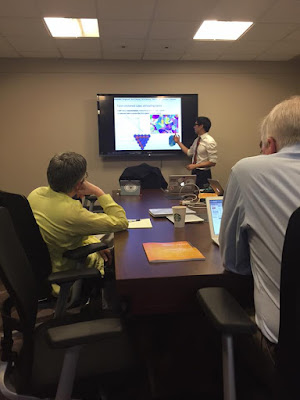
| Greg, as an expert, giving an keynote talk. |
Then the silence begins.
Arms crossed. Eyes closed. Fingers tapping on the desk.
And the silence continues.
"Well, if we really want to figure this out, we should probably try [y]." Pause, "Yeah, let's definitely try that first. I'm not entirely sure, but if it gives something, it should help explain [z]."
They've fallen from the pedestal I've placed them upon.
They're human, like the rest of us.
When this occurs, I realized how many years it's taken for them to become the experts of the field. How many experiments they must've performed. And how many hypotheses must've failed before getting to where they are.
It makes me feel infinitely better that I don't have the answers to everything, that I don't know everything, and that I won't do everything right. It takes time, and even then, like them, I still might not know.
 |
| I did my very best to find the most "normal" looking picture of my advisor to emphasis this point |
Subscribe to:
Posts (Atom)